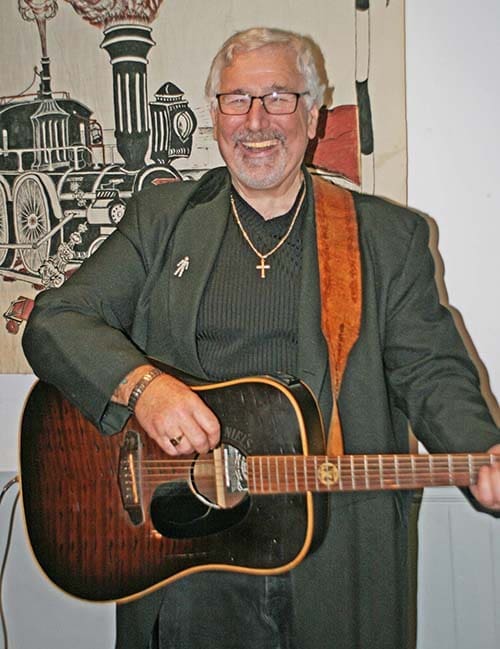
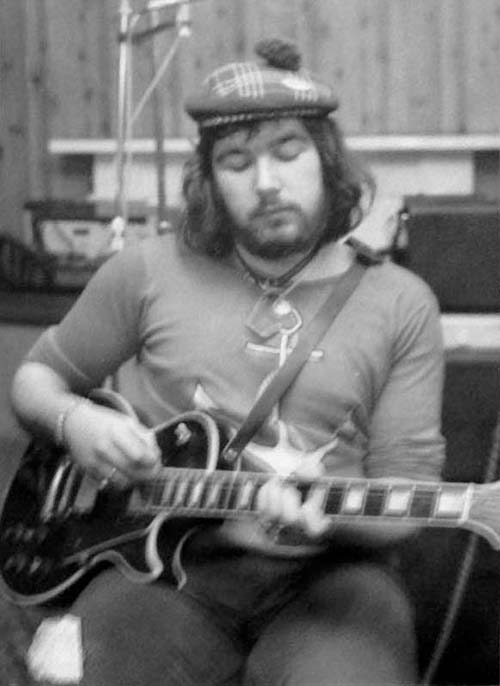
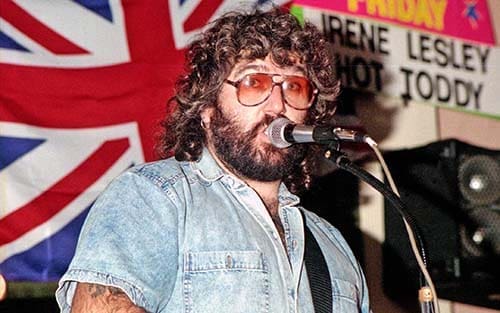
John Stubbs, better known to most people as Stubby has had a lifetime in the music industry stretching back to 1970 when, at the age of 16, he formed his first band called Circuit. They were a pop band with an emphasis on soul and Motown and once established they got a contract to work in the US air bases in Germany until Stubby was deported. Having returned to the UK in 1974 he formed a cabaret band called Mayfair and also worked in a couple of duos, guitar and drums but no backing tracks.
Their premature retirement was, however, short lived. In 1978 Malcolm teamed up with Jim Henshaw and John Stubbs who was now looking for a new band and they formed Captain Flint. Although primarily a soul band they were all fans of Dr Hook whose material provided the Country influence for the band. The following year saw further changes and Malcolm joined the Cumbria-based Dave Storey Band and by 1982 his interest in the recorded side of the music had taken more than a foothold and he set up a recording studio in Carlisle and engineered recordings for Maddy Prior and Rick Kemp of Steeleye Span, Michael Chapman and Martin Simpson (who recorded the soundtrack for the ITV children’s series Stookie).
After Captain Flint, Stubby formed Topper and Co, which he describes as ‘a really fun band; the rockiest, rolliest, drunkenist band ever’ – apparently they didn’t make much money but did they have a good time! It wasn’t long before Malcolm teamed up with Stubby again as Lemongrass Duo later in 1982 and they used backing tapes to produce the modern Country sounds of Rodney Crowell, Alabama, Willie Nelson, etc. This worked very well because by now Malcolm had seen the potential and had the facility to produce very good tapes so that it was possible to use reel-to-reel on stage rather than the poorer quality cassette.
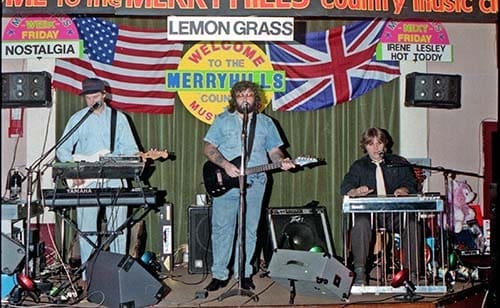
Malcolm’s heart was however in Country music and it wasn’t to be long before Lemon Grass was revived as a band (note the name became Lemon Grass at this time rather than Lemongrass). Their first Country line-up comprised Malcolm Mason (keyboards, lead guitar and vocals), Mike Wilding (vocals and rhythm guitar) and Geoff Betsworth (pedal steel guitar and acoustic and electric guitars).
Geoff started his music career back in 1967 playing finger-picking style guitar in southern folk clubs and he played in various folk and folk rock bands. During 1967 he picked his guitar non-stop for 12 hours (sponsored) at a local pub which stayed open all day. His friends at the time swore it was because it was his turn at the bar and it was the only way he could think of to get out of it. By 1979 he was playing pedal steel guitar, depping with Campbell Reid and the following year he formed the Georgia Country Band with Dave Porter. After moving to Cumbria in 1982 he joined local band, Harper Valley and then, in 1985, he joined Lemon Grass. It wasn’t long before Mike Wilding was replaced by Terry Mills on lead vocals and rhythm guitar. At this time Lemon Grass worked mainly in the north of England and won Clubland Country act of the year in about 1987. With the revival of Lemon Grass, Stubby started a solo career using backing tapes and this proved popular and carried on until the end of 1989 when he was in demand again.
It soon became clear that Lemon Grass would have to travel further afield and, in particular, to the south of England if they wanted to get more work. Terry had his own business and couldn’t commit to life on the road so Malcolm brought in his old band mate, John Stubbs on lead vocals.
Mick Green’s colourful description of Stubby in British Country Music Roots in October 1991 seems very accurate … ‘If Malcolm is the technician of the band, Stubby must be the minder. Big, hairy and covered in tattoos, he presents a fearsome sight off-stage. Lemon Grass do not feature percussions in their stage line-up but my trusty dictionary describes percuss as to strike sharply and l‘d have a shrewd guess that this big guy could do this to perfection if required. Although within this brash, bold and, at times, outrageous frame is a voice of pure Country gold which is one of the greatest assets that Lemon Grass has – something that no technician in the world can reproduce.’ The line-up was Malcolm Mason (keyboards, lead guitar and vocals), John Stubbs (lead vocals and electric guitar) and Geoff Betsworth (pedal steel guitar and acoustic and electric guitars).
It was with Stubby and Geoff that Lemon Grass really went to the top of the British Country music scene and this is the line-up that most people would remember. For two years running they were voted top British trio in the Country Music Round-Up and they brought out three very successful albums. The first, Lemon Grass, which included Mike Wilding on harmony vocals was only available as a cassette. The other two, Taking It To The Limit (1991) and True Brit (1993), were cassette and cd. Taking It To The Limit had 20 tracks, 10 live and 10 studio. True Brit featured a Geoff Betsworth song – A Breath Is All It Takes – which was also released as a vinyl single. Its beautiful lyrics and heart-string tugging melody made it the number one Country single in the UK. The more humorous side of the band brought them success Stateside when Malcolm’s song, Bingo Cowboy, a rather wry look at those clubs which seem to fit the bands in between the bingo sessions, charted in the US.
In 1994 Stubby left Lemon Grass to pursue a solo career and Terry Mills came back as lead singer for a while. In 1996 Stubby joined Colin Ford in a new duo called Second Chance. Colin Ford was the lead singer and songwriter in Nashville Fever who were formed in Norfolk in the early 1980s. Nashville Fever quickly became one of the busiest bands on the club and festival circuit. In 1990 they shortened their name to Fever because most fans referred to them as The Fever and their style of music was more Texas than Nashville. In 1993 Colin Ford left the band when he needed vocal cord surgery and he was replaced by Jim Kean. After the successful surgery Colin formed a new band, Lost Legends which comprised Colin Ford (lead vocals and rhythm guitar), Les Evans (lead guitar). Roger Ottley (bass) and John Hughes (drums). By 1996 Lost Legends had folded and this led to a collaboration between Colin Ford and Stubby.
Second Chance lasted for six years, coming off the road in 2002 when Stubby joined his next band, the Corn Dogs with Cliff Weston. On leaving Medicine Bow, Cliff Weston joined Band Named Sioux, staying for 18 months before leaving to form the Corn Dogs trio alongside Kevin Blake and Shane O’Borne who both played lead guitar. The Corn Dogs were very well respected with three versatile multi-instrumentalists and three good singers, both harmonies and lead vocals. There were several changes in the line-up. Shane was, in time, replaced by Rick McKay and later by Stubby who stayed with The Corn Dogs for two years, eventually leaving to resume his solo career. His place in the Corn Dogs was taken by Nadine Somers which brought a change in name to The Corn Exchange.
Stubby’s next band was Sidewinder trio with Stu Payne and Andy Saphir. Stu Payne had been a member of Peterborough Band Circuit Judge but the band folded in July 2002 following Pat Judge’s sudden death. In August 2003 Stu joined Sidewinder, a trio that had been together for a few years. The line-up at this time was John Stubbs (rhythm guitar and vocals), Andy Saphir (lead guitar) and Stu Payne (keys and vocals). Andy left c.2005/6 and Stu and Stubby carried on as a duo until the end of 2008 when Stubby decided once again to resume his solo career. Following the demise of Sidewinder, Stu formed a duo called Gemeni with Gemma Fairweather and now works with Texas Tornados. Stubby has continued working as a soloist since then apart from a collaboration with Julie Dawn in Country Dawn duo in 2017. They still work together occasionally and are planning to record a cd. John Douglas was born and raised in Jersey where, in 1988, he started working the local Country clubs and hotels during the summer season. He assembled his first Country band there and played regularly at the Wolves Cave Club in St.John.
John lists his Country influences as Garth Brooks, George Strait and Alan Jackson and this is evident both in his singing style and his own compositions.
Research by Nick Catford.