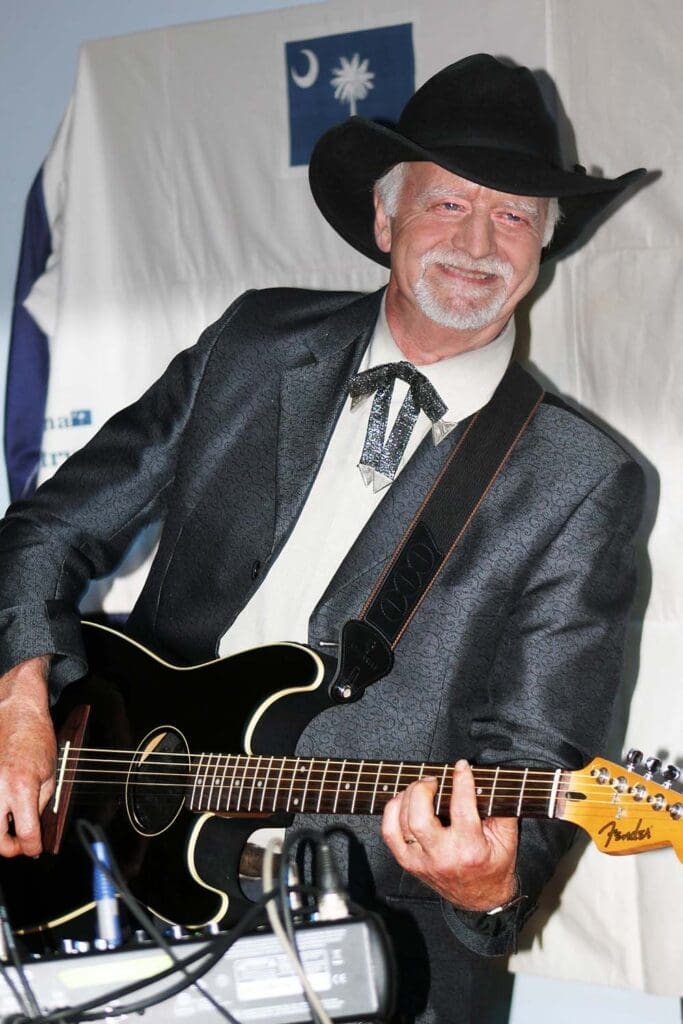
Peter Sunderland didn’t have any kind of musical background. He grew up in the 60s and 70s listening to chart music with his hero being David Bowie. He did like rock ‘n’ roll but Country music wasn’t even on the horizon at that time. When he was 16, his future wife’s dad used to play guitar. On a Saturday night they would all go to the pub and on their return Reg would get the guitar out and strum a few chords and they would all sing. Country music was his biggest influence and it was mainly Country he would play..
This was his first experience seeing live bands. He used to spend all night staring at the stage and this confirmed his love of Country music, the thought of being on stage and performing totally overwhelmed him. The first band he ever saw in the late 1970s was George Moody and the Country Squires.
Peter started to learn how to play bass guitar. By now he was married and his wife knew musician Tommy Levin’s girlfriend. She mentioned that Tommy and his brother Billy were considering starting their own Country band. They were all young and full of enthusiasm and Billy and Tommy were happy to take Peter on as a learner. Peter had got the performing bug so his journey began.
The Jailhouse Band was Billy & Tommy Levin’s first band, although they had previously played in Jess Country and it was very much ahead of its time. They wore Hawaiian shirts and it went over many people heads. Peter joined the band when he was 20 playing bass and he also did some lead singing. The band had a drummer but nobody regular so the nucleus of the band was Billy, Tommy and Peter.
The Jailhouse Band recorded a 4 track vinyl EP released on Velvet Records in 1983 (AM365). For that, the band members took stupid names. Billy suggested that Peter should be Pedro Rodriguez, The Gay Cabaliero. “I have never forgiven him for that name” Peter joked “I spent a long time trying to get rid of it but the name Pedro stuck with me and eventually I embraced it” Peter is still known as Pedro to many people to this day.
The Jailhouse Band were a weekend band and during the week Peter had his own business fitting double glazing; the Levin brothers were, and still are plumbers. Peter stayed with The Jailhouse Band for a couple of years but then it was time to move on to a busier band, Tallahassee.
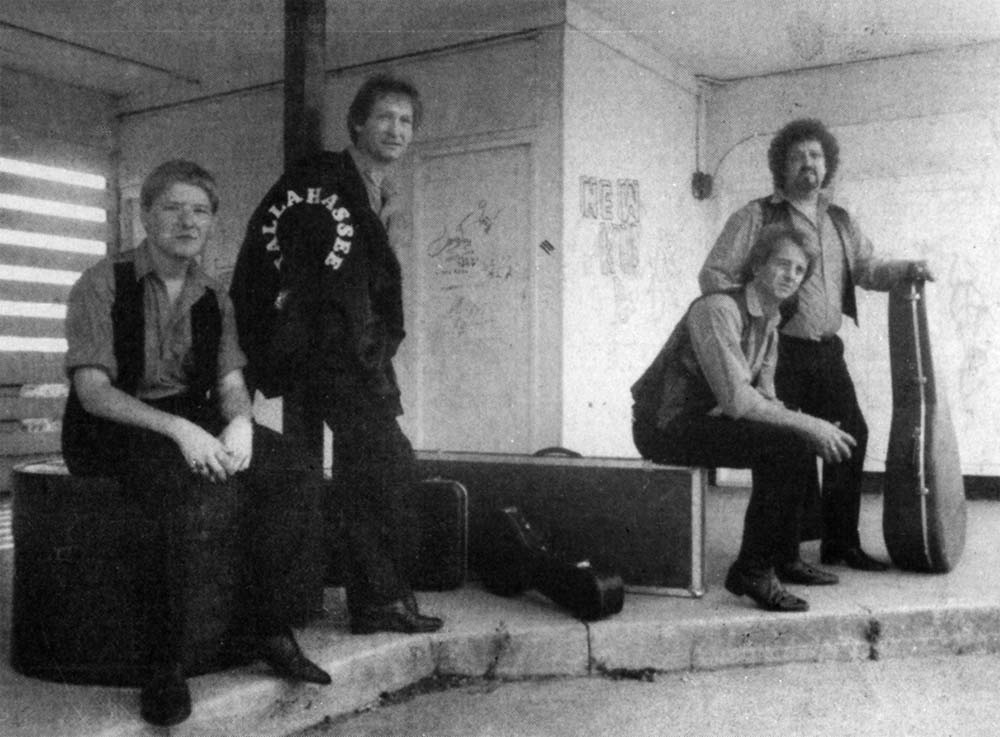
The band, fronted by Lyn Jones, quickly impressed everyone when it was launched in September 1986, and within the first two years they had made their debut at various Pontins festivals, the Norfolk Festival and the Good ‘n’ Country Festival in Kent and in early 1989 they had been appointed as resident Showcase Band for Pontins Festivals which saw them backing many of the showcase acts which often led to a jam session.
In the early days of the band, they stuck to a mainly traditional blend of music, and were quickly accepted on the club circuit on that basis: their first cassette album, which they recorded in May 1988, was very much in that style. By the end of 1988 they wanted to expand their music and, with some changes to the line-up which saw the arrival of Peter on bass guitar, lead and harmony vocals. Variety was the key to their success with everything from traditional country, ballads, western swing to modern up-tempo material Peter featured on the bands second cassette album ‘The Trot’ released in 1989. The album included a haunting, novelty song as its title track.
The Tallahassee line up at this time was Lyn Jones, lead vocals, rhythm guitar, mandolin and harmonica. Lyn also wrote some of the bands original songs. Peter, bass guitar and lead vocals. Keith Chinnery, lead guitar, lead vocals and sometimes steel guitar and dobro. Jason Lee Curtis, drums. Jason was one of the youngest drummers on the country circuit who started playing when he was 9. With three leads singers there were also close three-part harmonies.
From only working at weekends Peter was now very busy especially with the Pontins residencies. They would go to Hemsby (Great Yarmouth) for two weeks, then a week off followed by two weeks at Brean then another two weeks at Prestatyn. They also sometimes worked at Butlins, Bognor Regis backing a number of visiting bands. On one occasion at Hemsby, Lyn was taken ill and totally lost his voice for a couple of nights. As the show had to go on Peter stepped up to front the band. He later told Lyn it was a nightmare and he felt very uncomfortable doing it. But it went very well and was a good omen for the direction his career would soon be heading. After the event Lyn said to him “You have got it, you should be fronting a band.”
Peter feels that his time with Tallahassee was his apprenticeship with so much influence coming from some of the top British bands around at that time. He told me, “With Billy we were in our early 20s and it was just weekends and for fun and we were playing whatever we wanted to play which included many of Billy’s songs – he was in his early days of songwriting but had already written some good songs.” Tallahassee was totally different as they were fully pro although Peter did manage to fit in some of his double glazing work around band gigs.
There were several changes in the Tallahassee lineup including a number of top class musicians like Glen Mitchell, Billy and Tommy Levin on lead guitar and Karl Brazil on drums. In 1992, Karl Brazil and Glen Mitchell did a Pontins summer season at Skegness with the band, presumably in school holidays because of Karl’s age (15). Karl also jammed with the band in the late night disco/night club at Hemsby. Peter stayed for seven years until Tallahassee disbanded after which he and Lyn Jones worked as a duo, Alas Ped and Jones, for six months.
In 1994, Peter was contacted by Danny Lee from A Band Named Sioux. Their bass player Chewie had left without notice and with immediate effect and Danny was looking for a replacement.
There is no doubt that A Band Named Sioux was one of the most popular and successful bands on the club and festival circuit in the 1990s. The band was formed in 1989 and the original line up was Danny Lee on lead vocals and rhythm guitar, Stan Robinson on lead guitar, Mick McDonald on bass and Les Warner aka Les Glasscoe on drums. The band went fully pro in 1990 and at that time Rory McGregor replaced Stan on lead. The band really took off through the early 1990s touring widely throughout the UK and on the continent supporting Billy Jo Spears, Skeeter Davies and other artists on their UK tours. They were also Tommy Cash’s (Johnny’s younger brother) backing band on his UK tours.
There were a number of personnel changes over the years including Rufus Ruffell on lead guitar and Martin Kemp on bass, Mick Walton, Geoff Eatwell on pedal steel. With the departure of Chewie, Peter came in as his replacement in August 1995.
Peter considered his new band was a step up from Tallahassee as they had a much better overall sound with good harmonies and a wider variety of songs with more sophisticated arrangements. He chose not to sing any lead or harmonies concentrating on bass guitar which he feels did him the world of good. When he joined the band, the line up was Danny Lee, lead vocals and rhythm guitar, Rory McGreggor, lead guitar and vocals, and Les Glasscoe on drums.
Less than a year after joining, Peter got a phone call from Lyn Jones telling him that The Longriders were planning to move in a different direction and were looking for a new front man. Remembering how successfully Peter took over Tallahassee when Lyn lost his voice he felt Peter would be ideal for the job. Lyn suggested to Peter that he should meet the band and do an informal audition. Peter said “No” but Lyn was very persuasive and to shut him up, he agreed to do the audition but with no intention of joining.
The audition went well, much to Peter’s surprise, and the other band members said “Yes, let’s do it”. So Peter left A Band Named Sioux in June 1996 after only 10 months; and was replaced on bass by Terry Downing. He told me recently “It was a tough decision leaving to front The Longriders as I loved Band Named Sioux” At this time he switched from bass guitar to rhythm guitar as he felt the writing was on the wall for bass players and bands and he didn’t want to be out of a job at some time in the future. In ten years, A Band Named Sioux recorded six cassette albums, two of them including original songs but none of them featured Peter.
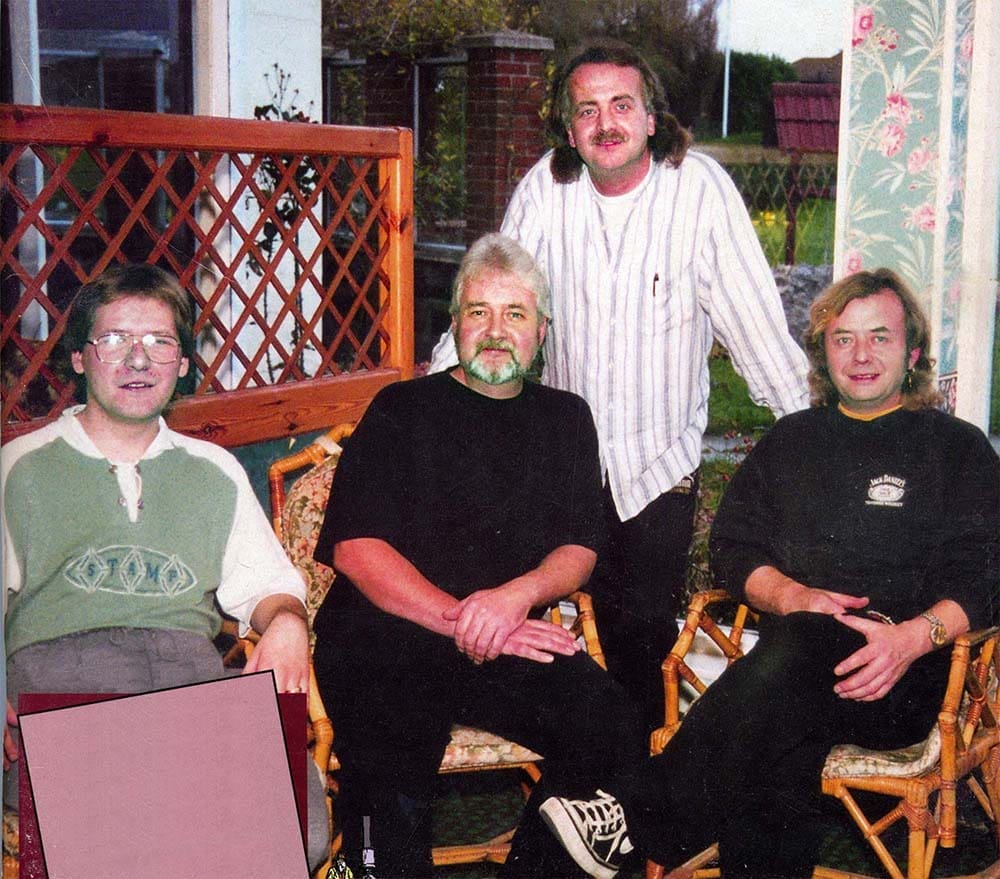
The Longriders, fronted by Vic Oakley, first appeared on the Country Music scene in September 1995. Vic started his Country journey with Easy Country before joining the newly formed Longriders in 1996. The other members of the Longriders were all members of George Moody’s band The Country Squires.
To celebrate George’s 25th anniversary in the music business a special dance was held at the Paddocks CMC at Canvey Island, a popular club run by Alan and Pam Woodhouse; Alan was Vic’s brother. A number of past band members attended this celebration. Soon after, George suffered a devastating blow with the departure of two members of his band. Les Evans and Keith Roscoe left together. Les spent a short time with Colin Ford’s new band Lost Legends but he and Keith soon joined Vic Oakley in the newly formed Longriders. Bass player Robbie Hawkes had planned to join the Longriders but he stayed in the Country Squires for a while as he couldn’t bring himself to tell George he was leaving but eventually he succumbed to temptation and after 12 years on bass he too left to join The Longriders.
With the arrival of Peter to front the band, the line up comprised Peter (lead vocals and rhythm guitar). Les Evans (lead guitar and lead vocals). Les had been playing lead guitar in country bands for many years joining his first band, Blazing Saddles in 1983. There were few players who could match his pedigree, his unique style and sound was a constant source of interest to other musicians as was his custom built guitar. Prior to joining the Country Squires in late 1992, he had also previously played with Johnny Carter and Hurricane Ridge and Clearwater Mountain He was a co-founder of the band and business-head of the Longriders.
Robbie Hawkes (bass, acoustic guitar, keyboards and lead vocals). Robbie was also the band‘s official treasurer. In late 1996 he added a new dimension to the band’s sound by introducing keyboards, enabling them to tackle a wider variety of material. Jason Lee Curtis (drums). Nicknamed ‘smiler’, Jason had a permanent grin across his face, both on stage and off – it’s even rumoured that he went to sleep smiling! Jason had previously worked with Peter for four years with Tallahassee before moving on to play drums with Barry Westbrook & Mean Business then with Shaun Michael.
Peter felt it was ironic when he joined the Longriders who were essentially The Country Squires without George. George Moody and The Country Squires had been the first Country band he ever saw in the late 1970s, albeit with a different line up to the Country Squires he found himself working with. Now he was fronting the band.
Within a few years of its launch, The Longriders had become one of the busiest bands on the club and festival circuit. It also helped that the four members had been good friends for a long time, after meeting up at numerous festivals over the years; they saw it as a natural progression to have ended up in the same band. At the time Peter said “Playing together is one thing, but getting on well as friends is even more important if you’re going to stay together”
Any early inhibitions about fronting a band soon abated as Peter feels he grew into the roll and it soon became very comfortable for him. Longriders only ever recorded one CD album, ‘Cover Story’ which was well received and sold well at gigs. At one time they backed Michael Twitty (Conway Twitty’s son). There were some changes to the line up with Andy Saphir coming in on lead guitar and Neil Harris on drums but Robbie was there on bass throughout his time with the band. Robbie always called Peter the brother he never had. “We just hit it off” he told me, “It was too much fun to be honest”. In his first year, The Longriders did 234 gigs with a lot of travelling. They remained very busy but the relentless pressure of work began to take its toll on Peter. They had a residency at Pontins and after a 30 day tour, another tour followed quickly followed by the ‘Selsey Party’ where Longriders were the resident band in the late bar. It’s there that Peter was taken ill in October 2001; he was rushed to hospital with a suspected heart attack. It wasn’t a heart attack but he was kept in for a week which gave him time to reflect on his future career.
By that time, bands were in decline and with the easy availibity of backing tracks a lot of artists were going solo. Peter decided to relieve the pressure and carry on as a soloist. The Longriders continued as a trio with Andy Saphir on lead guitar and lead vocals, Robbie Hawkes on bass and vocals and Neil Harris on drums; they folded a year later.
After being released from hospital, Peter took a year off and then made a tentative start as a solo artist c2003 with a handful of bookings off the usual dance circuit. They went well so he gradually built up a new solo act. When he went solo it made sense to continue calling himself Pedro, “it would have been stupid not to” he told me.
As a solo artist, he quickly started to get busy but still found time to get involved with other Country projects. In 2009 he joined Chris Mezza and Richard Edlin in Muddy Boots trio. If he couldn’t make a particular gig due to solo work, Chris Harris or Tony Crooks would stand in for him.
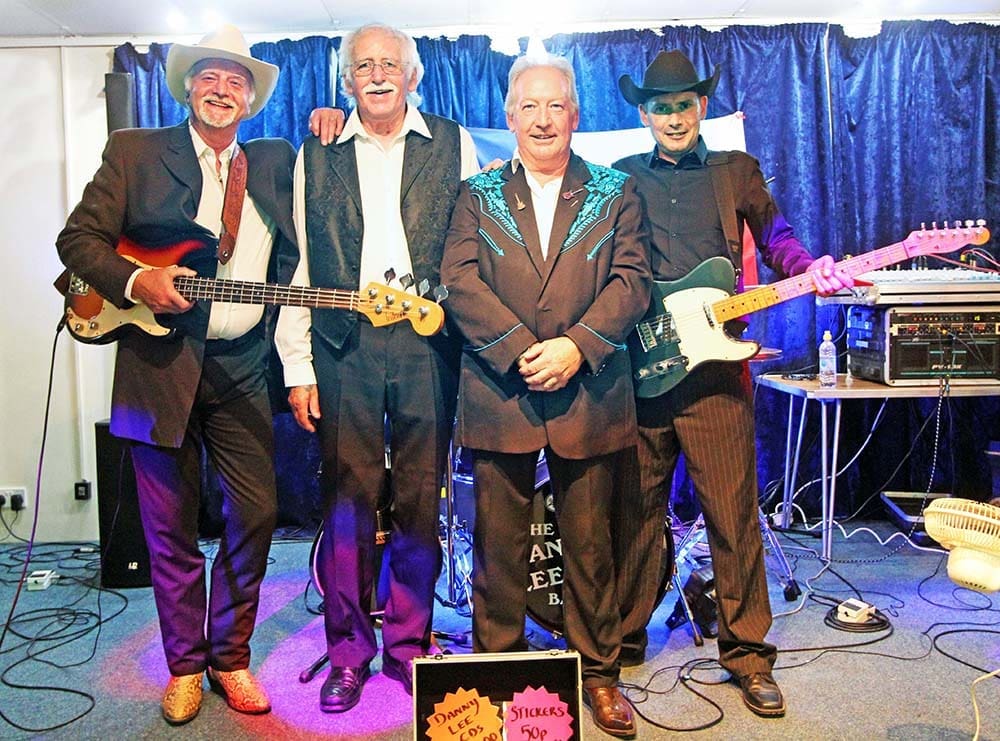
After working solo for many years, Danny Lee formed the four-piece Danny Lee band in 2013 in which he was reunited with Peter on bass two years later. The band also included Mark Jacobs on lead guitar and Martin ‘Biff’ Walsh on drums. They only did a few gigs; Peter also now works with Danny in Barlow and Lee duo. With a large number of line dance gigs coming his way Peter decided to drop the name Pedro at some line dance clubs while retaining the name at Country and Western clubs. He became known as Peter Barlow but there was some confusion with some clubs calling him Peter ‘Pedro’ Barlow.
Up until covid, Peter had a very full diary and 2020 would have been his busiest year ever as a soloist. It all came crashing down when lockdown arrived in March 2020. He waited for a couple of months but eventually decided he needed to get a proper job to pay the bills. Once live music returned, Peter decided to keep the job which now only leaves him two days a week (Friday and Saturday) for solo gigs. He has turned down a lot of work because he is working, often in the evening. He reaches statutory retirement age in 2025 so his plan is to take his pension and continue working as a soloist. He has already told all the agents that from next year he is available any day of the week. He has already been offered a tour of North East England so the future is looking bright.
After a lifetime in Country music Peter still enjoys playing. He describes himself as a man for all seasons with an extensive repertoire of songs that suits all types of dance and listening venues. With over 800 tracks available on his player. “I wouldn’t have changed anything” he told me recently, “thank God for ‘Uncle Reg’ as he calls his father in law. Without his love of Country music and playing, Peter’s life could have gone in a completely different direction. He still can’t really believe how everything panned out, he said “on reflection I’ve made the most of every opportunity Lady Luck has bestowed upon me”.
Research by Nick Catford.